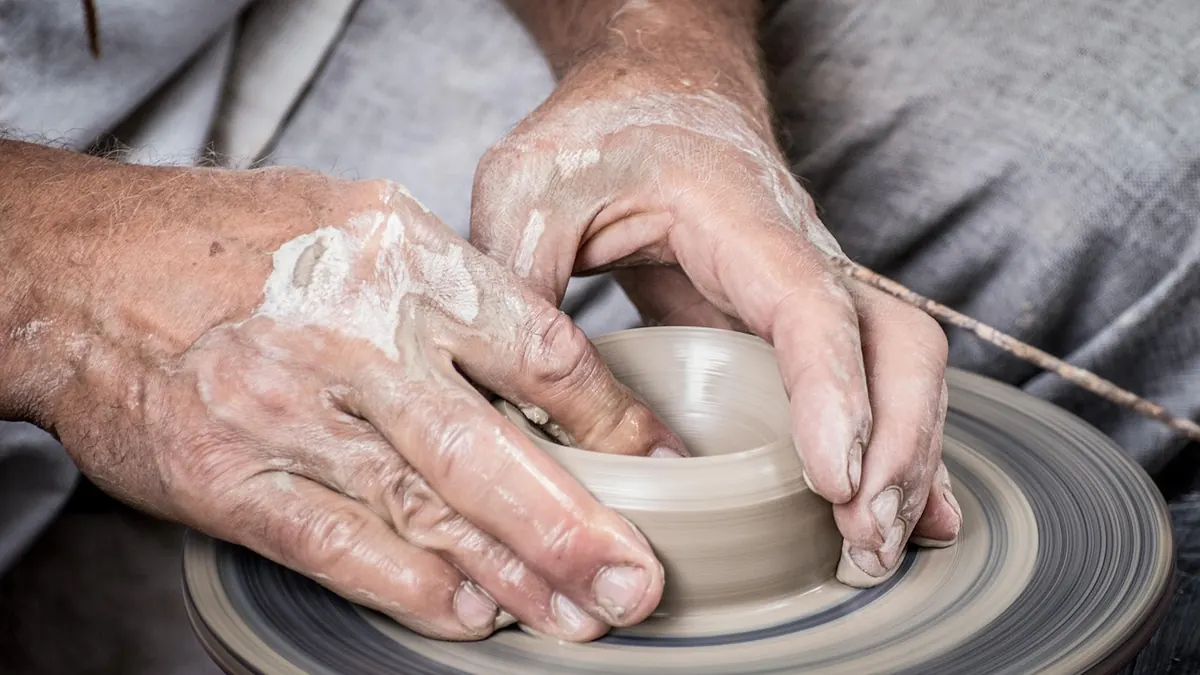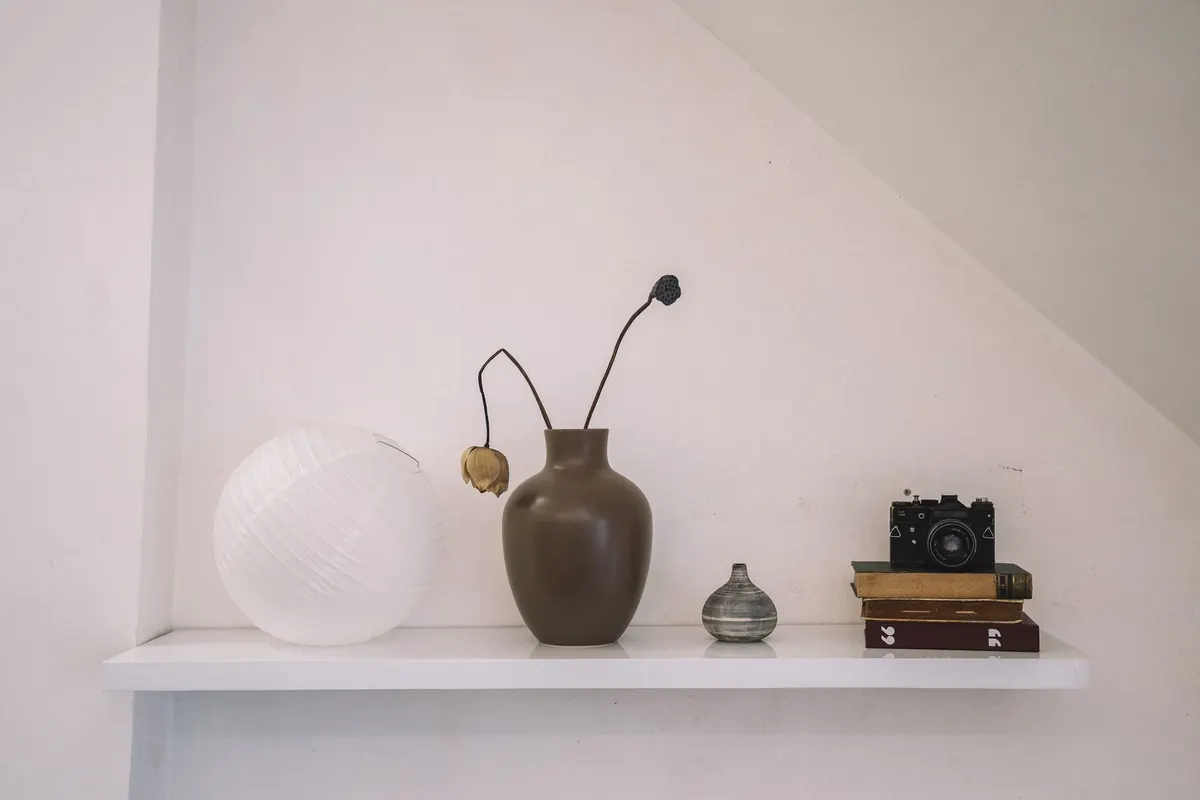
You can put three beautiful handmade pots on a shelf and end up with a jumble. Move them to a different surface, change the lamp, take one away, and suddenly the shelf looks like a photograph from a design magazine. The ceramics didn't change. The decisions around them did.
Styling handmade decorative objects is less about taste than about a few practical habits: measuring, editing, and paying attention to light. Most of the disappointing arrangements I've seen — including several of my own — come down to seven recurring mistakes. None of them require buying anything new. Here they are, with fixes that take minutes rather than a weekend.
1. Sizing Pieces for the Surface You Wish You Had
A 10 cm bud vase on a two-metre sideboard will always look like it's waiting for the rest of its furniture to arrive. Scale is the first thing the eye judges, before colour or texture, and handmade work is especially vulnerable: potters often work at an intimate size, and a piece that feels generous in the hand can vanish across a room.
Measure the space before you fall in love with an arrangement. As a rough guide, the tallest element in a grouping should reach about a third to a half of the height of the open space above the surface, and the widest should take up around a third of the width. On a long console, that usually means one substantial piece — a wide bowl, a tall bottle-form vase — plus two or three smaller ones in support. If you only own small pieces, group them tightly and give them a plinth. A stack of two art books will raise a modest bowl into the conversation.
2. Filling Every Square Centimetre
Clutter in ceramics rarely looks like clutter at first. Each piece was chosen, each one is lovely, and there's a story attached to every glaze. That's exactly how a shelf ends up with nine objects and no focal point.
Negative space is what makes handmade work readable. The eye needs somewhere to rest, and a piece needs air around it to show off its profile. Try this: arrange the shelf as you'd like it, then remove one piece. Often the remaining group looks better immediately, and the piece you took off can live somewhere else for a few months.
A practical rule for shelves: three to five objects along a metre of shelf, with gaps at least as wide as the widest object. On a dining table, one centrepiece and one small companion is plenty.
3. Groupings That Argue With Each Other
Mismatched doesn't mean diverse. Putting a rustic ash-glazed stoneware jar beside a glossy pastel figurine and a metallic candle holder doesn't give you contrast; it gives you three unrelated things sharing a surface. The eye reads that as noise, not as a collection.
What makes a grouping work is a shared thread — one thing that repeats. It might be colour temperature (all warm, earthy glazes), a shape language (rounded, organic silhouettes), a finish (matte and unglazed), or a single accent that ties the odd piece in.
A quick test for any grouping
- What do these pieces have in common — clay body, glaze family, mood, or simply the maker's hand?
- Is one piece clearly the lead, with the others in supporting roles?
- Would one of these look better in a different room entirely?
If you can't answer the first question, the group is probably a stack waiting to be separated.
4. Lighting That Flattens the Glaze
This is the mistake most people never notice, because bad lighting doesn't look like a problem — it just makes everything look ordinary. A handmade bowl under flat overhead light loses the depth of its glaze, the ridges left by the potter's fingers, the pooling at the rim. Photographers call that light "flat" for a reason.
Move a lamp so the light rakes across the objects from the side rather than straight down. Side light casts small shadows and makes texture visible. A warm bulb (around 2700–3000K) suits most earth-toned glazes; very cool white light can turn cream and honey glazes grey.
On shelves, a small clip-on or picture light works well, and if you can shift the shelf towards a window with soft daylight, do it. Above all, don't park your best pieces in permanent shadow under a taller object or a curtain of plant leaves.
5. Everything at the Same Height
A row of vases lined up along a shelf at identical height looks like a shop display rather than a home. Variation in height is what makes a composition feel deliberate, and it costs nothing.
Use what you already have: two or three stacked books, a low wooden tray, a folded linen runner with a board underneath. Put the tallest piece at one end and step down, or place the large piece alone and cluster two smaller ones beside it at a different level. Just keep the risers quiet — the point is the ceramics, not the staging.
6. Hiding the Handmade Part
One of the quiet pleasures of handmade ceramics is evidence of the hand: a thumbprint near the base, a slightly uneven rim, a glaze that breaks lighter over a ridge. Styling can erase all of it. A piece crammed into a tightly packed cabinet, turned so its best side faces the wall, or placed so high it can only be seen from below gives up what makes it worth owning.
Turn each piece until you find its good angle — usually where the glaze pools or the silhouette is clearest. Keep tabletop bowls low enough to be looked down into, because that's where they're most interesting. And leave a couple of pieces out for actual use: a jug holding spoons, a bowl for fruit. Handmade objects look their best in the middle of a life, not sealed behind glass.
7. Styling Once and Never Again
An arrangement is not a permanent decision. Light changes with the season, you get bored, and a piece that looked right in November can feel heavy in June. Homes that look effortlessly well styled are usually just edited constantly, in small increments.
Pick a moment — the first weekend of a new season works well — to swap two objects between rooms, turn a vase a quarter turn, or retire something to a cupboard and bring out a piece you'd forgotten. Rotation keeps a collection fresh and stops you buying more to chase the same feeling.
A Ten-Minute Reset
If you want to test all seven ideas at once, clear one shelf or table completely and start again:
- Choose a single lead piece — the largest, or the one you love most — and place it slightly off-centre.
- Add two supporting objects with a shared thread: same glaze family, same mood, echoing shapes.
- Vary the heights with a book, a tray or a folded cloth.
- Step back three metres and remove the piece you notice least.
- Turn on a side light and look again. If the texture disappears, the light is wrong.
- Live with it for a week before changing anything else.
Good styling of handmade ceramics isn't about owning more, or owning the most expensive piece in the room. It's about giving a few good objects the space, light and company they need. That's a small set of decisions, and almost all of them are free.
Photo: Anna Tarazevich / Pexels